
Oops, I forgot: Productive forgetting and convenient remembering
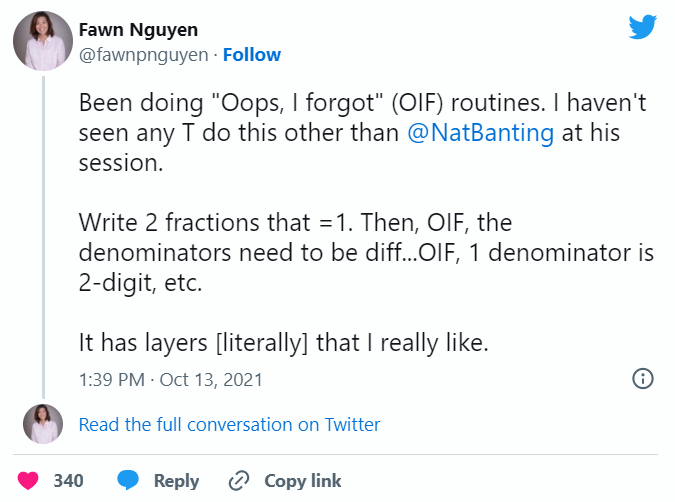
In 2018, I made the cross-country trip to attend and present at the OAME Annual conference in Toronto. The session was attended by a particularly boisterous group of math teachers—all of whom I adore. Emerging as the ringleader of this rag-tag group of pedagogical hooligans was Fawn Nguyen, who, in her notorious brilliance, later distilled the ideas into a classroom routine by the name “Oops, I forgot…”—OIF, for short. This post is in response to requests to elaborate a touch on the idea and provide more support for teachers thinking about implementing it in their practice.
Some background
At that time, I was thinking a lot about open tasks, and my session worked through my current ideas on how to instigate and amplify “openness” in a mathematics classroom, many of which were (and continue to be) inspired by the mathematics education research in the areas of enactivism and collective knowing (e.g., Davis, 1996; Towers, Martin, & Heater, 2013).
Stemming from these fields, the theme of the session was this: Open isn’t always better. Rich mathematical activity arises out of situations where there is a generative balance of freedoms and constraints. In other words, productive mathematical spaces are not completely filled with unbridled freedom, they are strategically limited.
As the participants worked together on this task, I kept shifting the constraints that they were required to satisfy, each time playing it up like I had forgotten to mention the conditions of the original prompt.
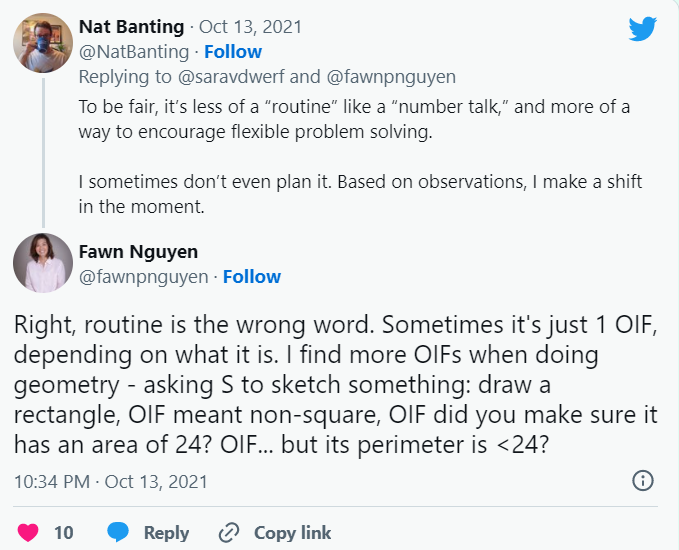
I envisioned the changing of constraints as a teaching move, an action (or reaction) of the teacher that happens in the moment of teaching. My big push was that teachers are responsible for cultivating this balance between freedom and constraint, and sometimes that means shifting it spontaneously while learning with students. Sponsoring this difference is where I believe the power of the strategy exists, and a productive imbalance can sponsor brilliant mathematical thinking. Modelling these “moves” was designed to empower teachers to observe the mathematical activity in their rooms and use constraints to play with what is mathematically possible as it unfolds.
I like this teaching move best when the additional information feels like a critical difference to the same task rather than a new task in a sequence of tasks. However, I love Fawn’s proposal of framing these ideas as a classroom routine, because it allows the teacher to practice changing constraints in a more controlled environment before adopting it as one (of many) possible teaching moves when teaching in the midst of more open mathematical spaces.
What makes “Oops, I forgot…” a great routine
- It works across topics. My favourite routines are those that can be widely adapted to address many mathematical outcomes. You can forget critical details about algebra, number, combinatorics, geometry, etc. etc. etc. You name it; I’ll forget it!
- It works across grade levels. In general, the theatrics become more transparent as you advance through the grades, but I did manage to pump fake a room filled with math education researchers and research mathematicians at the Fields Institute in 2020. (Video of the lecture found at this link. Scroll to the 28:15 to view the theatrics.)
- The learner is never to blame. It is one-hundred percent not their fault that the problem shifted. Actually, students suddenly love to discuss how their strategies were ruined because it was out of their control. Blame is deflected to the task itself or to the teacher. I wear this affliction wholeheartedly, but find that acting equal parts facetious and incompetent typically satisfies their disgust.
- Accentuates mathematical flexibility. Routines are designed to bring an ounce of familiarity to the classroom; however, there is the danger of any routine to become ritualistic. That, to me, is Catch 22 of classroom routines: if they become too familiar, they become mechanical. OIF focuses attention on differences and the ways to address them. It naturally promotes an open and flexible stance to what is mathematically possible.
- Fawn says so.
The structure of the routine
For me, an OIF consists of two pieces: a launch and a list.
The launch is the starting point for the routine. The more general the launch is, the more room there is to change things as the routine unfolds. Typically, the launch is fairly demanding on its own, asking students to build or design some mathematical object (think “create” level of Bloom’s). Since math is made richer with discussion, I like to have students in groups of three for the launch.
The list is a series of shifts in the original prompt that are “conveniently remembered” as the routine unfolds. I like to generate these by anticipating possible student strategies and then asking myself what new wrinkle would force that strategy to adapt. I’m careful not to shift the problem too much or too quickly. Doing so creates a sense of turbulence for those learners still working to get their bearings. I wait for ideas, strategies, and arguments to spread around the room before I speak up and share that “Oops, I forgot…”. I often ask students to share their responses or do a gallery walk before the list is employed. That way we honour the thinking before asking them to readdress it.
Be brave. Often times, I think of new things that I didn’t have on my original list, or students will suggest what they think is coming next. Don’t be afraid to deviate from your list. This comfort is part of the process of moving away from routine and toward an “in the moment” teaching move.
Some examples
Disclaimer: The goal here is not to simply provide examples, but for these examples to inspire your infinite creativity. Viewing mathematical activity through the lens of constraints places teachers at the crux of designing and shifting problem environments as they emerge.
Launch: Two friends are splitting a cookie. How much will each of the friends get?
List:
- OIF, I meant there are three friends
- OIF, there are actually four friends
- OIF, you brought two cookies to share
Launch: Build three different fractions that are between zero and one-half.
List:
- OIF, they cannot have a numerator of one
- OIF, they all need to have odd denominators
- OIF, they are not allowed to reduce
Launch: Five friends are taking a road trip in a 5-passenger car. How many ways can they choose seats for their trip?
List:
- OIF, Alex needs to sit next to Keaton
- OIF, Keaton needs a window seat
- OIF, Alex doesn’t have a driver’s license
One common thread across all of these examples is that a touch of purposeful amnesia can generate new mathematical possibilities.
NatBanting